Choosing rPET fibre for pillow filling involves more than checking the recycled-content percentage. Fibre structure and processing quality affect softness, loft, firmness, compression recovery and resistance to clumping. They also influence production speed and finished-product consistency.
This rPET fibre filling guide explains how to compare specifications, test samples and assess suppliers. It is designed for pillow makers, upholstery companies, filling converters and sourcing teams buying recycled polyester fibre for cushion filling in bulk.
What Is rPET Fibre Filling and How Is It Made?

From Recycled PET Bottles to Staple Fibre
rPET is polyester made using recycled polyethylene terephthalate. Post-consumer PET bottles are a common feedstock. The typical recycled PET bottle processing sequence includes:
- Collecting and sorting PET bottles
- Removing labels, caps and contaminants
- Washing and cutting the material into flakes
- Melting, filtering and extruding the PET
- Spinning the material into filaments
- Drawing and crimping the fibre
- Cutting it into rPET staple fibre
- Applying a siliconized or non-siliconized finish
- Compressing and packing the fibre into bales
Sorting, washing and melt filtration can affect colour, odour and process stability. Crimping, finishing and cutting have a direct effect on how the fibre opens, flows and performs inside a pillow or cushion.
Recycled Polyester Staple Fibre vs Virgin Fibre
Both materials are polyester, but their feedstock sources differ. Virgin fibre begins with new petrochemical raw materials, while recycled polyester staple fibre uses recovered PET. Performance depends on the fibre grade, feedstock consistency and production controls. Recycled origin alone does not guarantee that a fibre will perform like a specific virgin grade.
Is rPET Fibre Safe for Pillows and Cushions?
Suitability depends on chemical inputs, manufacturing controls and the rules of the destination market. Buyers should request current test reports relevant to the intended use. OEKO-TEX STANDARD 100 testing may be useful in some markets, but the required evidence will depend on the finished product.
Recycled content does not automatically prove chemical safety or hypoallergenic filling properties. Covers, additives, factory hygiene and third-party testing may also affect finished-product claims.
Why Use Recycled Polyester Filling?
Filling Power, Loft and Low-Weight Bulk
Crimped fibre traps air between its strands. Hollow fibre can also hold air within its structure. Together, these features can create visible volume without excessive filling weight. However, apparent fullness and total fibre weight are not the same.
A high-loft grade may achieve the required shape with less material than a dense grade. Buyers should compare cost per finished item, not only cost per kilogram.
Softness, Resilience and Moisture Performance
Polyester filling can provide a soft tactile feel, useful rebound and practical care. It absorbs relatively little water compared with many natural materials, which can support quicker drying. Actual moisture management performance still depends on the shell, inner liner and complete cushion design.
Well-made fibre should recover after pressure and retain its shape through normal use. Resilience after repeated use should be confirmed through prototypes and repeated-compression tests.
What Are the Limitations?
- Low-quality or poorly opened fibre may form lumps.
- Weak crimp or poor recovery can cause early flattening.
- Fine fibres may migrate through loosely woven shell fabrics.
- Unsuitable washing or drying can increase fibre migration and clumping.
- Polyester textiles may release microfibres during use or laundering.
- Bottle-to-fibre recycling is not the same as closed-loop fibre-to-fibre recycling.
Which rPET Fibre Specifications Matter Most?
Core Specifications to Compare
- Fibre denier: Influences softness, structure and bulk. Fine fibre often feels softer, while coarser fibre can add body.
- Cut length: Affects opening, blending, feeding and filling machine compatibility.
- Hollow structure: Can increase air retention and loft. Buyers should check void consistency, not just a “hollow” label.
- Crimp: Supports fibre cohesion, bulk and springiness. Crimp consistency matters across each lot.
- Siliconized finish: Reduces fibre-to-fibre friction and creates a smoother hand.
- Non-siliconized finish: Provides more grip and may suit firmer fills or selected blends.
- Compression recovery: Shows how well the filling rebounds after repeated loading.
- Moisture content: Can affect handling, storage and the effective weight of a bale.
Fibre Denier and Cut Length
Lower denier usually creates a finer feel, while higher denier may provide more support. Neither option is universally better. The right fibre denier and cut length depend on the shell, machinery, target firmness and product type.
Conduct a pilot test before approving a grade. A fibre that feels good by hand may separate poorly or feed slowly through production equipment.
Hollow Conjugated Fibre Structure
A hollow conjugated fibre structure can combine internal voids with three-dimensional crimp. This design may improve bulk, springiness and compression recovery. Still, the term “hollow conjugated” does not describe the complete performance level. Uniformity, crimp stability and recovery must also be checked.
Siliconized Fibre Finish
A siliconized fibre finish lets strands slide past one another more easily. It is often selected for smooth, down-like filling. Non-siliconized fibre has greater friction and may create a firmer structure. Manufacturers can blend the two to balance softness and pillow firmness and support.
Filling Power and Compression Recovery
Ask prospective suppliers for bulk-density or filling-power data, initial loft and results after conditioning. Repeated-compression data should include the test method and conditions. Buyers should also agree on acceptable lot-to-lot tolerances rather than relying on one ideal sample.
What Is the Best rPET Fibre for Each Application?
Sleeping Pillows
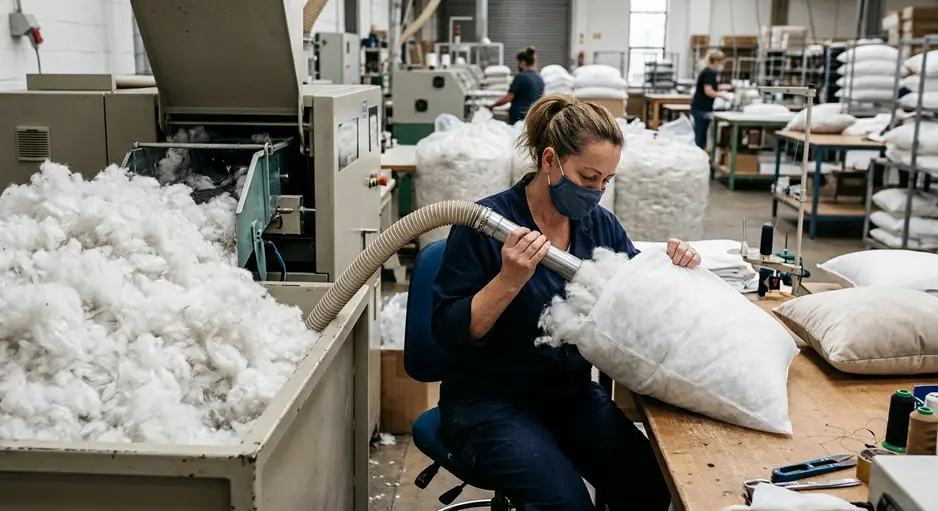
The best rPET fibre for pillow manufacturing should match the intended comfort level. Common priorities include a soft surface, high loft, good rebound, low dust, low odour and minimal migration. The material should also run smoothly through blowing or stuffing machinery.
Fine, hollow and siliconized fibre is often considered for soft-fill pillows. Manufacturers may adjust filling weight or use a blend to create soft, medium and firm product ranges.
Decorative Cushions
Recycled polyester filling for decorative cushions often needs strong visual fullness and shape retention. A high-bulk siliconized grade can create a plush appearance. Buyers should also assess how often the cushion will be washed or reshaped.
The shell fabric must be dense enough to contain the selected fibre. Inner liners can offer added control where migration is a concern.
Sofa Cushions and Fibre Wraps
Recycled polyester fibre for sofa cushions may be used in loose-fill back cushions or as a wrap around foam. Sofa backs often require higher recovery and better shape retention than decorative cushions. Fibre wraps need even thickness and a smooth surface.
Loose fibre alone may not provide enough support for every seat design. Seat cushions can require foam, springs or a structured core to meet upholstery durability requirements.
Quick Application Guide
- Sleeping pillow: Prioritise softness and rebound; consider fine, hollow, siliconized fibre.
- Decorative cushion: Prioritise loft and appearance; consider high-bulk siliconized filling.
- Sofa back cushion: Prioritise resilience and shape retention; consider higher-recovery fibre or a blend.
- Foam wrap: Prioritise smoothness and even coverage; consider consistent carded fibre or batting.
These are starting points, not fixed specifications. Every recommendation should be validated through finished-product prototypes.
How Should Manufacturers Test rPET Filling?
Run a Sample-to-Production Trial
- Request technical data sheets and representative samples.
- Condition each sample under the same conditions.
- Fill identical pillow or cushion shells.
- Use the same fibre weight for each comparison.
- Record filling time and machine behaviour.
- Measure initial loft, firmness and shape.
- Conduct repeated-compression testing.
- Inspect for lumps, leakage and migration.
- Wash-test the finished item where relevant.
- Approve realistic production tolerances.
Check Filling Machine Compatibility
Monitor bale opening, fibre separation, static, dust, feeding consistency and blockages. Record blow-fill speed and check whether fibre spreads evenly inside the shell. A soft grade may still be unsuitable if it slows production or creates uneven filling.
How Can Manufacturers Prevent Clumping?
Select fibre with consistent crimp and finish. Store bales in dry conditions and allow proper conditioning before opening. Avoid overfilling, which can restrict movement and create hard areas. Suitable shell construction and validated washing and drying instructions can also reduce clumping.
How to Choose an rPET Fibre Supplier
Verify Recycled Content and Traceability
Ask whether Global Recycled Standard or Recycled Claim Standard documentation is available. Check the certificate holder, validity dates and scope. Transaction certificates may be required for certain supply chains.
Buyers should also request the recycled-content percentage, feedstock details, batch identification and chain-of-custody records. A sustainability logo or general statement is not a substitute for valid documentation. ISO 14021 offers guidance for self-declared environmental claims.
Compare Technical and Quality Controls
A recycled polyester fibre manufacturer should be able to discuss denier and cut-length tolerances, crimp, finish, colour, odour and bale weight. Also review lot traceability, packaging details, sample support and the process for handling non-conforming goods.
When assessing an rPET fibre exporter or bulk supplier, compare minimum order quantities, lead times, repeat-shipment consistency, export packaging, Incoterms and market-specific documentation.
Questions to Ask Before Requesting a Quote
- Which application is this grade designed for?
- Is the fibre hollow, solid, conjugated or blended?
- Is it siliconized or non-siliconized?
- What are the denier and cut length?
- Which recycled-content records are available?
- What loft and recovery values have been tested?
- Can you provide a production-lot sample?
- Which tolerances are guaranteed?
- How are complaints and non-conforming lots handled?
Buyers comparing an rPET fibre bulk supplier for home furnishings can contact Saheb Fibre to ask about available specifications, samples and bulk-supply information. Confirm all required technical and compliance documents before placing an order.
Practical Buying Example and Common Mistakes

Example: A Medium-Firm Pillow
A manufacturer wants a pillow with a soft surface and medium support. The sourcing team shortlists several hollow siliconized grades and produces equal-weight samples. It measures loft, rebound, filling time and shape after repeated compression.
If one sample feels too soft, the team can increase fill weight or test a blend with more fibre-to-fibre grip. The final prototype should become the approved reference for future deliveries.
The lowest price per kilogram may not provide the lowest cost per pillow. Higher-loft fibre may require less material, run faster or reduce rejected items.
Common Procurement Mistakes
- Buying on price alone
- Choosing by recycled percentage without performance testing
- Treating all hollow fibre as identical
- Ignoring shell-fabric compatibility
- Failing to define production tolerances
- Approving only a hand sample
- Making unsupported environmental or hypoallergenic claims
- Failing to check certificate validity and scope
Choose Fibre Based on Measured Performance
Effective sourcing starts with the finished product. Define the required softness, loft, support, recovery and care performance before comparing grades. Then test representative samples under controlled conditions and record how each option performs in production.
The right rPET fibre for pillow filling should combine verified recycled content with stable specifications, efficient processing and dependable finished-product results. Clear tolerances, traceable documents and production trials help buyers choose with confidence and build more consistent pillow and cushion ranges.
Frequently Asked Questions About rPET Filling
1. Is rPET Fibre Good for Pillow Filling?
Yes, a suitable grade can provide softness, loft and useful recovery. Results depend on denier, cut length, crimp, finish and filling weight. Buyers should test the fibre in the intended shell and on actual production machinery.
2. What Is the Best rPET Fibre for Pillow Manufacturing?
There is no universal best grade. Hollow siliconized fibre is often considered for soft, high-loft pillows. The final choice must match the required firmness, support, shell construction, filling equipment and care instructions.
3. Does Recycled Polyester Cushion Filling Clump?
It can clump when the fibre, opening process, fill method or laundering conditions are unsuitable. Consistent crimp and finish, proper bale opening and tested care instructions can help reduce the risk.
4. Is Recycled Polyester Filling Hypoallergenic?
Polyester is often selected as an alternative to animal-derived fillings. However, “hypoallergenic” is a finished-product claim. It should be supported by suitable evidence that considers the filling, cover, additives and manufacturing conditions.
5. How Much rPET Fibre Is Needed for a Pillow?
The required weight depends on pillow dimensions, fibre loft, shell construction and target firmness. Create several weight-controlled prototypes and compare their comfort and recovery instead of relying on one universal quantity.