Should you purchase recycled PET flakes or ready-to-process recycled polyester staple fibre? Both materials may begin as post-consumer PET bottles, but they enter production at different stages. The right choice depends on your machinery, technical skills, final product, and total conversion cost.
This guide compares PET flakes vs RPSF by material form, processing requirements, quality controls, applications, and supplier selection. It will help you choose an input that works with your equipment rather than relying on price per kilogram alone.
PET Flakes vs RPSF: The Quick Answer
Choose PET flakes if your plant has suitable drying, extrusion processing, melt filtration, and polymer or fibre-spinning equipment. Flakes give you more control over additives, colour, filtration, and the final fibre grade. However, they also require greater technical skill, energy, testing, and process control.
Choose RPSF if you need fibre that is ready for opening, blending, carding, spinning, needle punching, thermal bonding, or filling. Your supplier must provide the correct denier, cut length, crimp, strength, finish, colour, and fibre structure for your application.
Comparison at a Glance
Raw material form
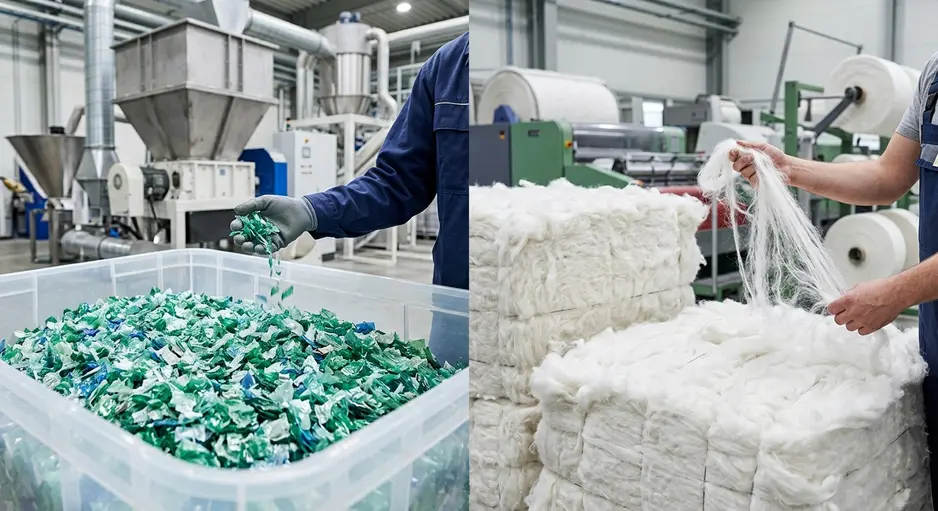
PET flakes are cleaned pieces of recycled plastic. RPSF is cut staple fibre supplied in bales.
Machinery required
Flakes need drying, extrusion, filtration, and polymer-conversion equipment. Staple fibre generally needs bale opening, blending, carding, spinning, nonwoven, or filling machinery.
Main quality focus
Flake buyers check intrinsic viscosity, moisture, colour, and contamination. Fibre buyers focus on denier, cut length, tenacity, crimp, shrinkage, and finish.
Best suited to
Flakes suit polymer and fibre converters. RPSF suits yarn spinners, nonwoven producers, felt plants, and filling-product manufacturers.
What Are PET Flakes and RPSF?
Recycled PET Flakes as an Industrial Feedstock
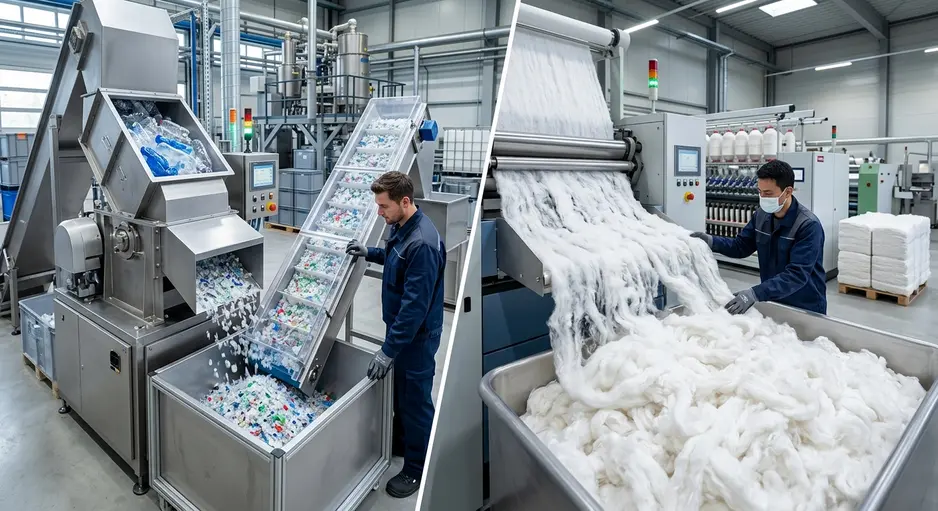
Recycled PET flakes are small pieces of PET produced mainly through PET bottle recycling. A typical process includes sorting, label removal, grinding, washing, separation, rinsing, and drying. The resulting material may be clear, light blue, green, or mixed in colour.
Not all bottle flakes are suitable for polyester production. Their performance depends on material purity, moisture, flake size, bulk density, thermal history, and intrinsic viscosity. PVC, glue, metals, labels, polyolefins, dust, and excessive fines can create serious processing problems.
For this reason, recycled PET flakes for industrial processing should be purchased against measurable limits. A general description such as “washed bottle flakes” does not confirm that the material can run well on a melt-spinning line.
Recycled Polyester Staple Fibre as a Textile Input
RPSF is a fibre product made by converting recycled PET into short, controlled lengths. It may be solid or hollow, siliconized or non-siliconized, and supplied in several colours, deniers, and cut lengths.
Common RPSF applications include recycled or blended yarn, nonwoven fabrics, felt, geotextiles, insulation, filtration media, automotive products, cushions, pillows, quilts, toys, and other soft filling products. The correct grade depends on how the fibre must behave during production and in the finished item.
How Does the Bottle-to-Fibre Process Change the Material?
The bottle-to-fibre process usually follows this sequence:
Post-consumer PET bottles → sorting → washing → PET flakes → drying → extrusion → melt filtration → melt spinning → drawing → crimping → cutting → RPSF
From PET Bottle Recycling to Extrusion
PET is sensitive to moisture and heat during remelting. If moisture is not controlled, the polymer may degrade and lose performance. Drying conditions must therefore match the feedstock, dryer, extruder, production rate, and intended product.
Contamination may also change melt flow characteristics. PVC, glue, metals, and non-PET plastics can raise filter pressure, affect colour, cause fibre breaks, and increase waste. Good material does not remove the need for filtration, but it can improve production efficiency and batch stability.
There is no universal drying setting or intrinsic viscosity value for every line. Processors should establish an acceptable range through equipment guidance, laboratory checks, and production trials.
Melt Spinning and Staple Fibre Production
After drying, the polymer is melted and filtered. It is then passed through spinnerets to form continuous filaments. These filaments are drawn to develop their properties, crimped, heat set, finished, and cut to the required length.
An RPSF buyer receives material that has already passed through these stages. A flake buyer takes responsibility for polymerisation-related control during remelting, fibre spinning, quality checks, yield loss, and equipment performance.
Key Differences Between PET Flakes and RPSF
Material Form and Handling
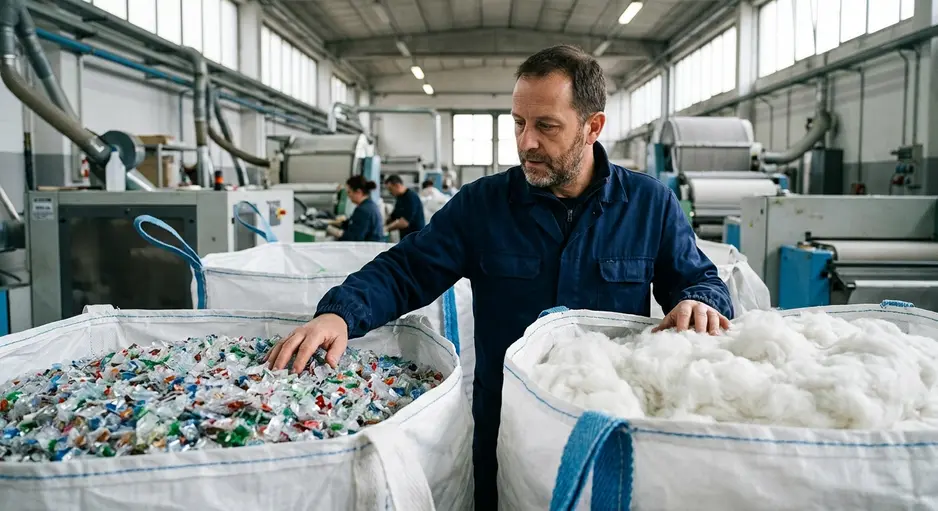
Flakes are irregular, free-flowing pieces that may create dust or fines during transport and conveying. Their bulk density affects feeding and storage. They must also be protected from moisture and outside contamination.
Staple fibre is normally compressed into bales. It needs suitable warehouse space, bale-opening systems, and careful lot control. Fibre compression and opening behaviour can influence blending and carding performance.
Processing Requirements and Machinery
A plant using flakes may need:
- Controlled drying or crystallization equipment
- Dehumidification and moisture testing
- Dosing and blending systems
- An extruder and melt filters
- Pelletising, sheet, strapping, or fibre-spinning equipment
- Laboratory and in-process polymer testing
A plant using staple fibre may need:
- Bale opening and blending systems
- Carding and spinning preparation
- Needle-punching or thermal-bonding equipment
- Web-forming, felt, or filling machinery
- Fibre and finished-product testing
Quality-Control Priorities
Important PET flake checks include intrinsic viscosity, moisture, flake size, colour consistency, fines, PVC, metals, glue, labels, and polyolefin contamination. Batch identification is also important when investigating a processing change.
For RPSF, buyers should check denier or dtex, cut length, tenacity, elongation, crimp, shrinkage, finish, colour, and bale consistency. The specification should also state whether the fibre is hollow or solid and siliconized or non-siliconized.
Total Cost and Production Efficiency
PET flakes may have a lower purchase price because they are an earlier-stage raw material. Yet that price does not include drying, energy, filtration, labour, maintenance, rejects, testing, or yield loss.
RPSF includes more upstream conversion in its purchase cost. It may still provide a lower cost per acceptable finished unit when a buyer does not operate an efficient fibre-production line. Freight, storage, downtime, and batch consistency also belong in the calculation.
Which Material Fits Your Manufacturing Process?
When Should You Choose PET Flakes?
PET flakes for polyester production are a practical option when your facility operates suitable extrusion and melt-spinning machinery. Your team must be able to manage drying, contamination, filtration, melt pressure, colour, and polymer performance.
Flakes may be preferred when you want more control over additives, fibre structure, denier, or colour. They may also be used to make PET sheet, strapping, pellets, filament, and other products where staple fibre is not the required input.
Before selecting a PET flakes supplier for recycling industries, confirm that the offered specification matches your equipment. Ask for test methods, tolerances, batch records, and representative samples. A laboratory result is useful, but a production trial gives stronger evidence of compatibility.
When Should a Textile Manufacturer Choose RPSF?
RPSF is normally the better choice for yarn spinners, nonwoven producers, felt manufacturers, and filling-product plants. These operations use fibre directly and may not have polymer drying, extrusion, filtration, or melt-spinning systems.
An RPSF supplier for textile applications should offer a grade that matches the end use. Fine fibres may support certain yarn or nonwoven requirements, while hollow siliconized grades are often selected when softness, recovery, and loft are important.
Buyers should compare specification consistency, line performance, waste, and finished-product results. The cheapest bale can become expensive if it causes poor opening, uneven carding, web defects, yarn breaks, or inconsistent filling weight.
PET Flakes vs RPSF for Textile Manufacturing
RPSF production line
Better starting material: PET flakes. The plant is designed to convert recycled polymer into staple fibre.
Recycled yarn spinning
Better starting material: RPSF. The fibre is ready for opening, blending, carding, and spinning preparation.
Needle-punched nonwovens and felt
Better starting material: RPSF. Controlled fibre length, denier, crimp, and strength support web formation.
Cushion and pillow filling
Better starting material: hollow siliconized RPSF. Loft, softness, recovery, and handling are key requirements.
PET sheet or strapping
Better starting material: PET flakes. Converting the polymer into staple fibre would add an unnecessary stage.
Integrated bottle-to-fibre operation
Better starting material: PET flakes. The facility can control the full conversion process.
How Should Buyers Evaluate Quality and Suppliers?
Request Technical Documents
For flakes, request details about the source stream, washing method, colour grade, intrinsic viscosity range, moisture limit, contamination limits, size distribution, and lot identification.
For fibre, request the fibre type, cross-section, denier tolerance, cut length, tenacity, elongation, crimp, shrinkage, finish, siliconization, bale weight, and packing details. Ask for a current technical data sheet and certificate of analysis where available.
Test the Material on Your Equipment
Begin with a controlled sample or smaller lot. During flake trials, monitor drying performance, melt pressure, screen changes, colour, fibre breaks, waste, and output stability.
During RPSF trials, review bale opening, blending, static, carding behaviour, web uniformity, yarn evenness, bonding, bulk, and recovery. The exact checks should reflect the intended product.
Do not approve a long-term specification after one successful sample. Repeated lots provide better evidence of batch consistency and supplier control.
Supplier Qualification Checklist
- Clear traceability and lot coding
- Documented quality-control procedures
- Defined test methods and tolerances
- Laboratory or third-party testing support
- Reliable production and delivery planning
- A complaint and corrective-action process
- Recycled-content documentation when required
- Suitable packaging and shipping documents
Industry guidance from organizations such as the Association of Plastic Recyclers, RecyClass, PETCORE Europe, NAPCOR, and Textile Exchange can support internal purchasing standards. If a recycled-content claim or certification is required, verify the exact scope and current documentation with the supplier.
Best Practices for Better Processing Results
Match the Specification to the Product
A label such as “textile grade” is not enough. Define the properties that affect your finished product, then agree on limits, tolerances, and test methods before repeat orders.
Control Moisture and Thermal History
Store flakes in clean, dry conditions and follow equipment-specific drying guidance. Track filter changes, melt pressure, residence time, colour variation, waste, and fibre breaks. These records help your team detect small changes before they cause a major stoppage.
Validate RPSF Across the Full Line
A fibre may pass incoming inspection but behave differently during carding or bonding. Test it through the full process and measure the properties that matter, such as yarn strength, web uniformity, tensile performance, bulk, recovery, or filling consistency.
Choose the Material That Matches Your Process
PET flakes are best for businesses equipped to handle polymer drying, extrusion, filtration, and fibre or product conversion. RPSF is the practical input for textile, nonwoven, felt, and filling plants that need ready-made staple fibre.
Base your decision on equipment, specifications, total conversion cost, and repeated batch performance. If you are unsure which recycled PET material fits your operation, contact Saheb Fibre to discuss your equipment, end application, required specifications, and sample needs.
Frequently Asked Questions
1. Can PET Flakes Be Used Directly to Make Polyester Fibre?
They can be used as feedstock, but they must normally be dried, melted, filtered, and passed through suitable fibre-production equipment. Flakes cannot replace staple fibre in a conventional carding or yarn-spinning process.
2. Is RPSF the Same as Recycled PET?
No. Recycled PET is the wider polymer or material category. Recycled polyester staple fibre is a specific product made by converting recycled PET into fibres of a controlled length and specification.
3. Which Is Cheaper: PET Flakes or RPSF?
Flakes may cost less to purchase, but they require further conversion. Compare drying, energy, filtration, labour, maintenance, yield loss, testing, and capital costs. The best measure is cost per acceptable finished product.
4. What Intrinsic Viscosity Is Needed for Fibre Production?
There is no single value for every process. The suitable range depends on the feedstock, fibre type, spinning line, processing conditions, and required performance. Buyers should set the range with their technical team and supplier.
5. Are All Recycled PET Flakes Suitable for Textile Fibre?
No. Moisture, PVC, glue, metals, polyolefins, excessive fines, colour variation, or polymer degradation may cause poor filtration, fibre breaks, unstable spinning, and quality defects.